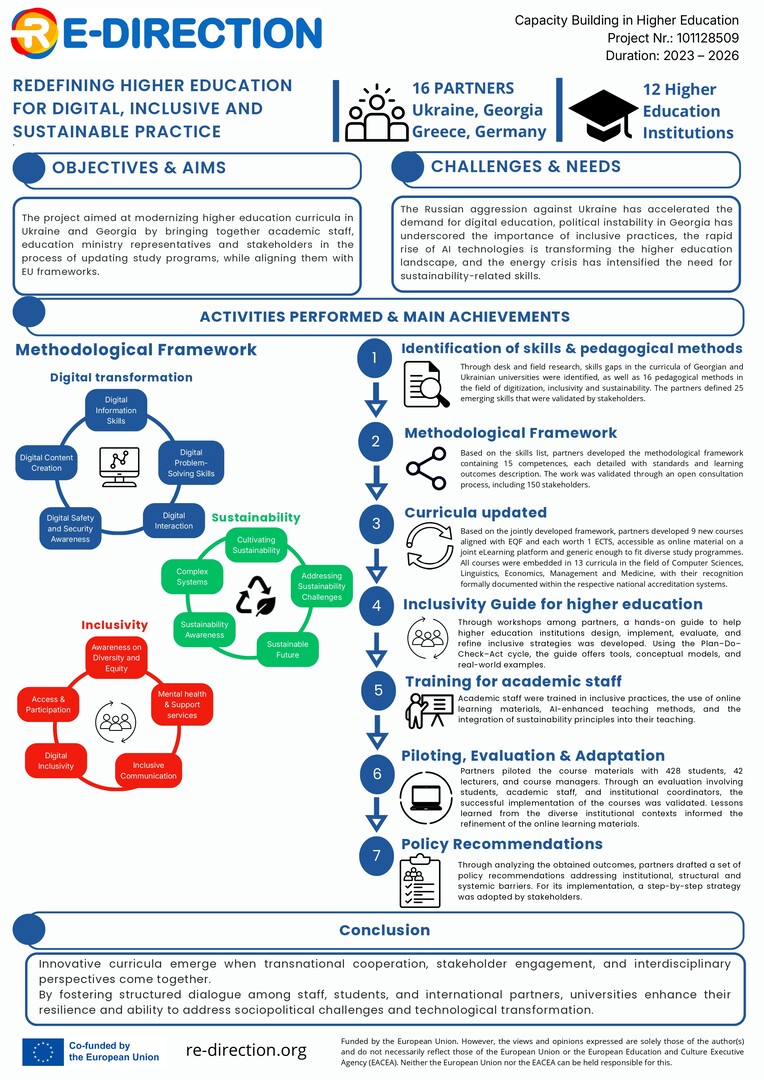
The Erasmus+ Capacity Building in Higher Education project RE-DIRECTION - Redefining Higher Education on a digital context, while promoting a common, inclusive and sustainable framework based on EU best practices and policy recommendations has successfully concluded. The project made a significant contribution to the development and strengthening of the capacities of higher education institutions in Georgia and Ukraine.
The project was implemented over three years, from November 2023 to October 2026, bringing together 16 partner organisations from Georgia, Ukraine, Germany and Greece, including higher education institutions and national education authorities. It was coordinated by Karlshochschule International University (Germany).
RE-DIRECTION aimed to support the modernization of higher education. Its focus was on integrating digital, sustainability-related and inclusive competences into academic programmes, as well as developing sustainable approaches to distance and blended learning.
Key Achievements and Results:
Throughout its implementation, the RE-DIRECTION consortium achieved a number of important results aimed at developing higher education systems and improving the quality of teaching in the participating countries. The project delivered the following results:
- 13 curricula were revised, incorporating relevant competences in digitalization, sustainability and inclusivity;
- 9 new courses were developed, available as Open Educational Resources (OER) in Georgian, English and Ukrainian;
- 29 policy recommendations were developed in cooperation with the Ministries of Education of Georgia and Ukraine to promote inclusive and sustainable distance and blended learning;
- An Inclusive Teaching Guide was developed, bringing together 20 practical tools;
- Five training sessions were delivered to support the professional development of university educators and academic staff.
The courses developed within the project were tested by more than 400 students, nearly 95% of whom provided positive feedback on their learning experience. The courses were designed to be accessible via mobile devices and to function even in conditions of unstable internet connectivity. This is particularly important for higher education institutions operating in remote or crisis-affected regions.
Another important focus of the project was cooperation with policymakers in the field of education. Together with the Ministries of Education of Georgia and Ukraine, the consortium developed 29 recommendations addressing issues such as ensuring the continuity of educational activities in emergency situations and the responsible use of artificial intelligence. The recommendations were developed in cooperation with project partners and representatives of the respective ministries, and were jointly reviewed and agreed upon.
The completion of RE-DIRECTION does not mark the end of the activities initiated through the project. On the contrary, the results achieved provide a foundation for their further use and development, both within partner universities and across the wider higher education community.
The educational resources, revised academic programmes and methodological materials developed through the project enable higher education institutions to continue introducing innovative teaching and learning approaches beyond the project's implementation period and to further strengthen digital, sustainable and inclusive education practices.
The continued availability of the Open Educational Resources developed within the project is also important, as it supports knowledge-sharing, the adoption of new approaches to teaching and learning, and the expansion of educational opportunities. These resources remain accessible to higher education institutions, academic staff, students and other interested stakeholders through the project website: https://re-direction.org/
Another significant sustainable outcome of the project is the strengthened cooperation between higher education institutions and education policymakers. The jointly developed policy recommendations provide a foundation for further dialogue and informed decision-making on the development of digital higher education.
Participation in RE-DIRECTION contributed to strengthening the institutional capacities of higher education institutions, fostering international academic cooperation and promoting the exchange of European best practices.