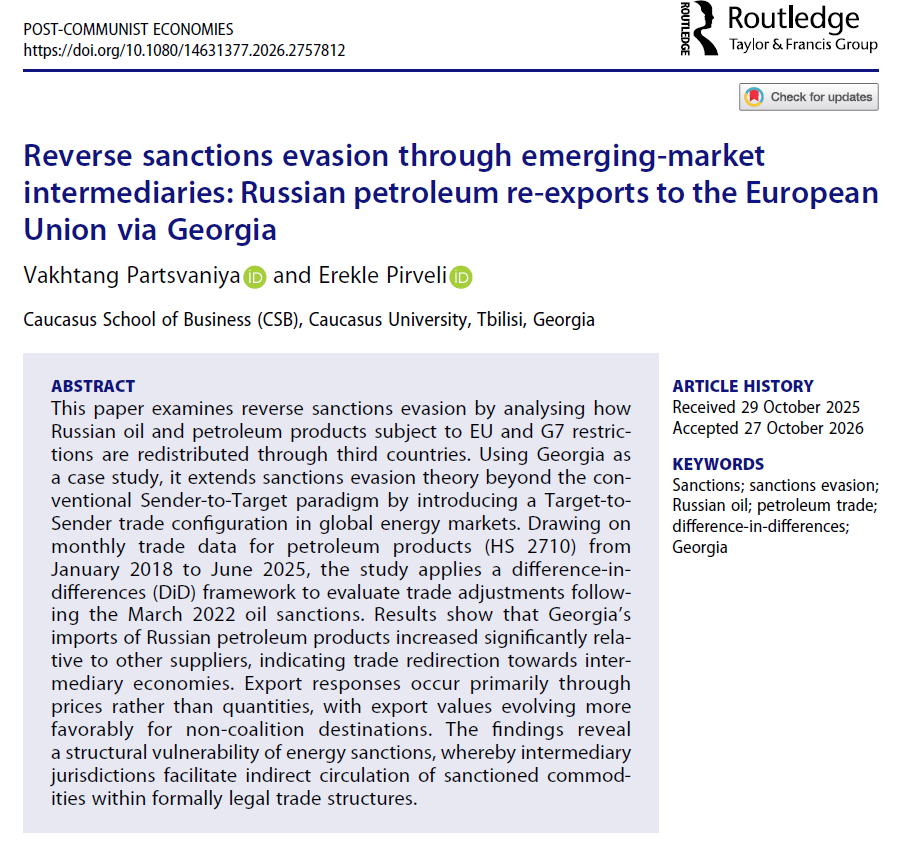
A new article by Professor Vakhtang Partsvaniya and Professor Erekle Pirveli of the Caucasus School of Business (CSB), Caucasus University, has been published in Post-Communist Economies (Routledge / Taylor & Francis). The article is titled “Reverse sanctions evasion through emerging-market intermediaries: Russian petroleum re-exports to the European Union via Georgia”.
Research on sanctions evasion has mostly focused on Western goods reaching Russia through third countries. The authors look at the reverse direction and introduce the concept of reverse sanctions evasion, in which goods from a sanctioned country circulate back towards sanctioning markets through intermediary states. They test the concept on Georgia’s petroleum trade, using monthly trade data for petroleum products from January 2018 to June 2025 and a difference-in-differences research design.
Key findings:
- After the oil sanctions took effect in March 2022, Georgia’s petroleum imports from Russia increased significantly, by about 56,000 tons per month relative to other suppliers.
- Georgia’s petroleum exports adjusted mainly through prices rather than quantities, with export values moving in favour of nearby non-coalition destinations (Armenia, Azerbaijan and Turkey).
The findings point to a structural weakness of energy sanctions: intermediary jurisdictions can pass sanctioned commodities along within trade structures that are formally legal. The authors argue that effective enforcement requires closer tracking of origin, routing and re-exports through third countries, so that regulators can see which products go where and through which channels.
The article is available at the following Link