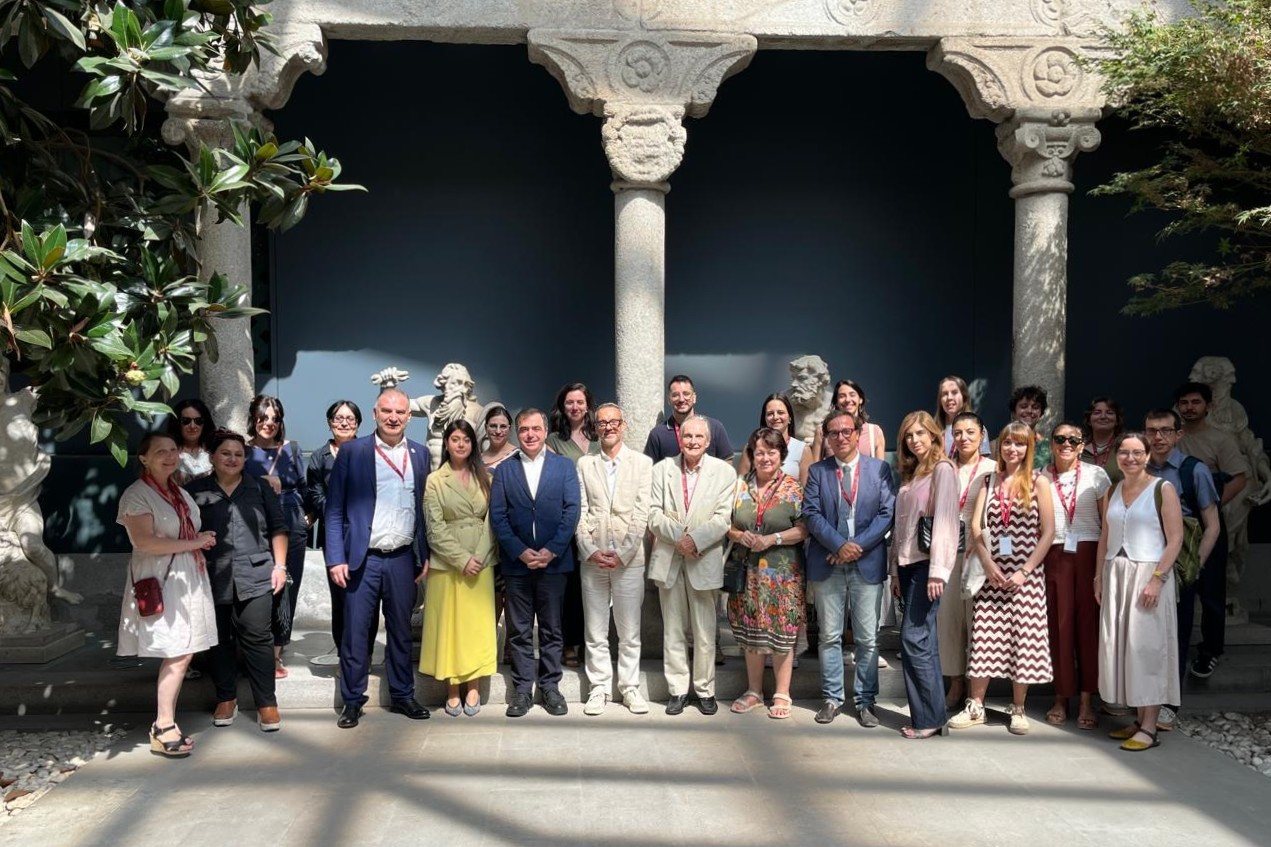
The 2nd International Scientific Conference, “Two Iberias – Two Gateways to Europe”, was held in Madrid on 10-12 September. The international academic forum was organised through the collaboration of Complutense University of Madrid, San Dámaso Ecclesiastical University, Ivane Javakhishvili Tbilisi State University, and Caucasus University. The Embassy of Georgia to the Kingdom of Spain was also involved in the conference, contributing to the successful organisation of the event and strengthening academic cooperation between Georgia and Spain.
The three-day scientific forum took place at the Faculties of Philology and Philosophy of Complutense University of Madrid, San Dámaso Ecclesiastical University, and the Museum of San Isidro. The conference programme featured 27 presentations and five keynote addresses. Participants included representatives of Complutense University of Madrid, the Universities of Barcelona, Seville, Málaga, and Valencia, as well as Sorbonne University and San Dámaso Ecclesiastical University.
The Georgian delegation included researchers and academic staff from Ivane Javakhishvili Tbilisi State University, Caucasus University, and Free University.
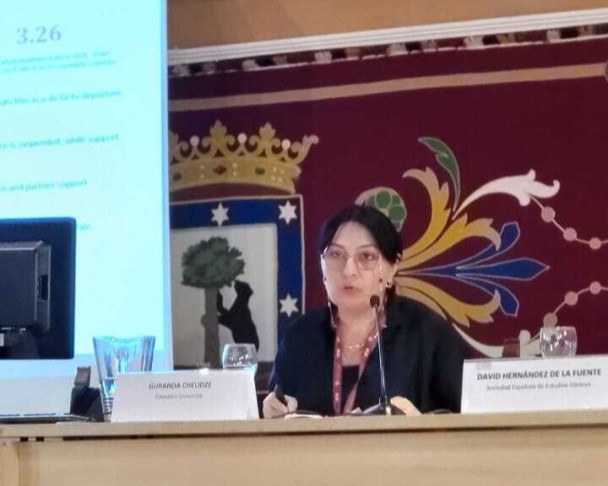
Caucasus University was represented by its President, Professor Kakha Shengelia, who participated as a keynote speaker. The conference was also attended by Professor Guranda Chelidze, Head of the Irakli Tsereteli NATO Research Centre.
Professor Guranda Chelidze presented the findings of her research conducted during the 2025–2026 academic year, entitled “Two Iberias – Georgia and Spain: Contemporary Geopolitical Challenges.”
The paper provides a comparative analysis of the geopolitical locations, foreign policy priorities, and security environments of the two countries. Particular attention is devoted to the impact of Russia’s full-scale invasion of Ukraine in 2022 on the European security architecture and the implications of the war for the strategic interests of Georgia and Spain.
The paper examines Spain’s geopolitical role as a member of both the European Union and NATO, as well as its strategic interests in Europe and the Global South. With regard to Georgia, the research focuses on the strategic importance of the Black Sea region, Russian influence, the security threats arising from the occupation of Abkhazia and the Tskhinvali region, and the country’s process of Euro-Atlantic integration.
One of the key aspects of the research is an examination of NATO’s role in ensuring Georgia’s security and maintaining regional stability. The paper highlights that, despite their different geopolitical environments, both countries face the challenge of safeguarding their strategic interests within the international security system and adapting to an evolving geopolitical landscape. In this context, strengthening cooperation with Western partners, including NATO, and advancing Euro-Atlantic integration remain particularly important for Georgia.
The publication of the conference proceedings is scheduled for summer 2027.